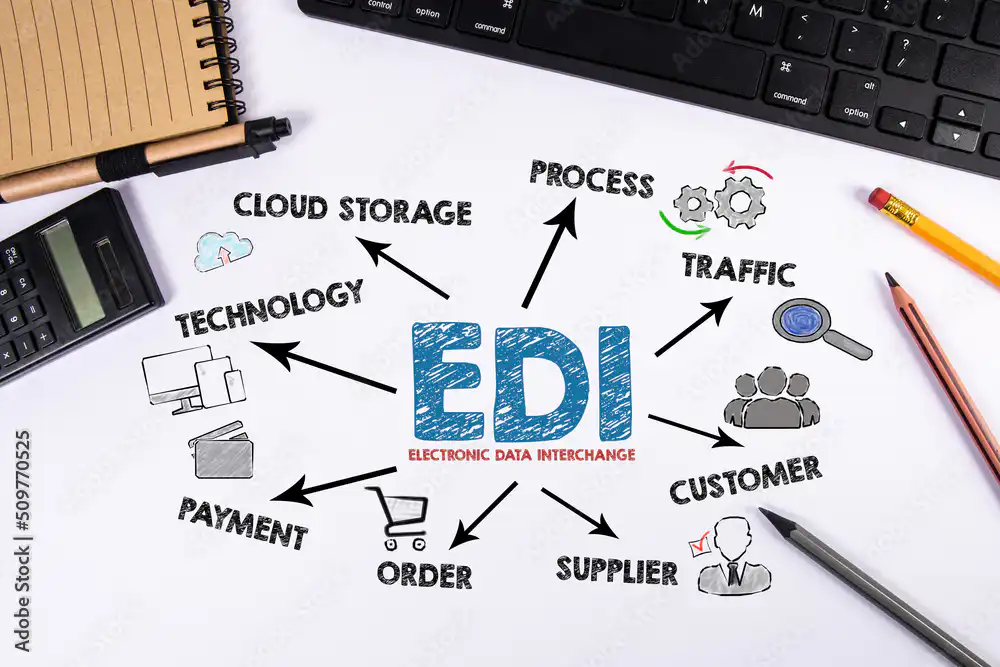
With EDI (Electronic Data Interchange), companies—in this case, customers and suppliers—exchange data electronically. The goal is to make transactions as easy and fast as possible. For beverage distributors and importers who frequently deal with batches, returnable containers, and expiration dates, EDI is a convenient way to have all the necessary data available in your ERP system right away. For customers, too, EDI is increasingly becoming a dealbreaker. An integrated solution with your ERP system is the best way to achieve an efficient workflow.
How Does Electronic Data Interchange (EDI) Work?
In short, EDI enables your ERP system in conjunction with your client's ERP system. Often, an intermediary is brought in who specializes in converting the sender's format to the recipient's format.
For example, as a beverage distributor or craft brewer, you might receive an order for 1,680 crates of Sint-Bernardus Abt 12 via EDI. Drinkmaster 365 will receive this EDI order and add it to the EDI orders, and will also immediately indicate whether everything is correct with the order. Errors are highlighted right away so you can resolve them. If there are no errors, you can easily convert the EDI order into a purchase order.
After that, this order follows your company’s workflow. When you’re ready to deliver the order, you can use EDI again to send the shipping or dispatch notice to your customer. This way, your customer knows exactly what’s coming before the physical delivery takes place. You can even send the invoice for that shipment to your customer via EDI.
Simplify Data Exchange with EDI
First and foremost, no more manually entering items, quantities, and prices. Orders just need to be approved before they’re sent to your warehouse. Then you can ship and invoice immediately after your customer receives the order.
It’s also convenient for your drivers, by the way, because they no longer have to carry paperwork with them. The details—including the delivery time—are already in your customer’s system before the driver arrives. Customers can even request a delivery time slot via EDI.
EDI also enables lot tracking, and you can easily print SSCC labels through the ERP system. SSCC is a widely used standard for pallet labels, often combined with EDI. The codes on these labels contain all the information about the items, right down to the expiration date. Errors are therefore easily detected and reported back to the supplier, who can then replace or reship the items before issuing an invoice.
What about the prices?
When your customer sends an order via EDI, it includes the expected price. However, the prices in your ERP system take precedence. These price differences may result from a recent price change or a different rounding method. However, the price in the supplier’s ERP system always takes precedence, so your prices will be adjusted accordingly.
Setting up your EDI takes some work, because each of your customers and suppliers needs to be assigned a GLN number. Products being traded are assigned a GTIN number. We link those numbers to your ERP system. ESC has experience with various EDI providers (such as Babelway) and has the necessary infrastructure to thoroughly test your EDI system. We’d be happy to discuss with you exactly how this works for your beverage or wine business. Feel free to contact Sign up for a no-obligation consultation.