
Lately, more and more companies have been starting to use Power BI. It’s a popular product—people have heard of it—and it’s easy to download yourself, for free. Self-service BI is popular. The barrier to building a dashboard is low, and it quickly looks very polished and interactive. So what’s the added value of a data warehouse or a semantic layer if everyone can just get started with Power BI on their own?
Data Source
When people within an organization start using Power BI as a self-service tool, we often see that Power BI is populated with Excel files. These Excel files are frequently exported from a source application and then—before being loaded into Power BI—are often not edited at all. Updating a report requires a number of steps, and the source of the data for the various dashboards can sometimes be difficult to trace. Before you know it, the organization is making decisions based on a dashboard where no one has ever properly verified whether the data is actually accurate.
Organizations that already retrieve data directly from the source system think they’ve avoided these problems, but even then, it can be very helpful to consider the architecture. A model in Power BI is set up that way, but where do you store your definitions, and how do you ensure that the tables are always linked correctly?
Semantic layer
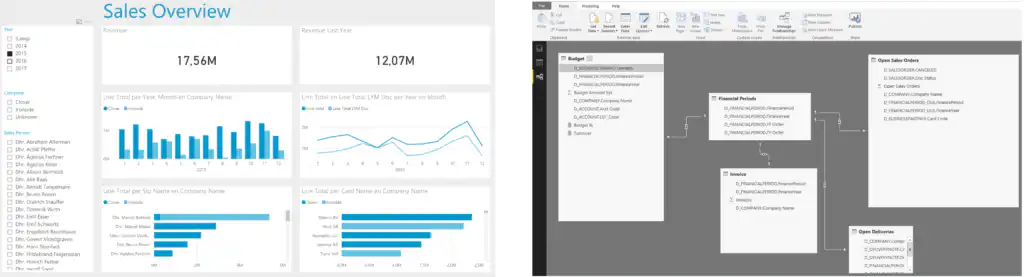
Using a semantic layer between the database and the reporting tool can eliminate many of the problems listed above. A semantic layer (or data management layer) is essentially a physical or virtual layer between the data source(s) and the reporting tool, where the data is translated into a model that is easy for the end user to work with. A commonly used solution for this within the Microsoft BI stack is cubes. These also offer the added benefit of allowing you to connect to them live using Power BI. So what is the added value of a semantic layer between the database and the reporting tool?
- Definitions can be recorded in one place
- Modeling only needs to be done once
- The modeling is done correctly, ensuring that everyone has the right figures
- An end user doesn't need to know anything about databases
- Reports can be generated using business terms
- Depending on the architecture, the database system is not constantly burdened with queries
- The same data can be reported on using different tools
Development Under Control
By providing end users with a high-quality and user-friendly reporting environment, it is also possible to prevent a proliferation of reports within the organization. All reports connect to various source systems in the same way and can be stored in a structured manner, either on-premises or in the cloud. Using the various security options, it is also possible to determine who is authorized to view which data and who can modify or create which reports.
Conclusion
The rise of self-service BI is certainly not a bad thing, but as an organization, you should carefully consider how you deploy the various tools and how manageable they are. Using Power BI to quickly analyze specific data can be very valuable, but if the reports become a daily topic of discussion, it might be a good idea to take a critical look at the architecture and how the tool is being used.