
Why the Best BI Solutions Will Still Need a Human Architect in 2026
Then Microsoft Copilot for the first time in the Fabric Ecosystem When it was introduced, the conversation focused mainly on questions such as: “How do I write a DAX measure?” or “Can you create this report for me?”
Fast forward to today, and we're past the novelty phase. If Senior BI Consultant at Alistar I've seen that while AI is indeed a tremendous catalyst, its true value lies not in replacing developers—but in enhancing the entire BI lifecycle.
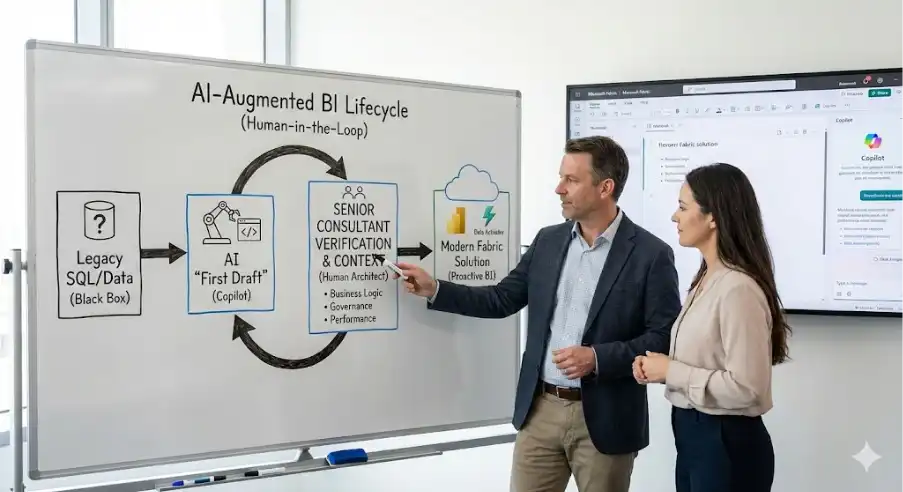
If you want to go beyond basic automation and enterprise-grade data solutions If you want to build something, it's time to stop treating Copilot (or any other AI agent) like a search engine and start using it as a Technical Peer Reviewer.
Here's how we integrate AI into the modern Microsoft stack to better and more robust results to be delivered.
Modernizing the “Black Box” of Legacy SQL: A Case Study
Every organization has one: a A 1,000-line SQL stored procedure, written ten years ago, that handles a critical business process—such as Inventory Aging or Month-End Commissions.
It works “just like that,” but it’s a a black box that no one dares to touch.
We recently worked with a client to migrate such a "black box" from an outdated on-premises SQL Server toward a modern Microsoft Fabric environment. Here's how we used AI to achieve better results:
The Translation
We used AI to analyze over 800 lines of nested logic. Within minutes, it identified a “hidden” recursive loop that was causing the report to take three hours to run every morning.
Modernization
Instead of simply copying the old code, we used AI to rewrite the logic into a Fabric Notebook using PySpark. This allowed us to move the processing from a single database engine to a distributed cloud environment.
The Alistar Touch
Although the AI proposed the new code, our consultants discovered that the original logic did not take into account a return policy that had been updated in 2023.
So we didn't just modernize the technology; we also corrected the business logic.
The result:
A process that used to take 180 minutes is now completed in less than 12 minutes.
And for the first time in ten years, the customer has a clear and documented explanation of how their inventory calculation actually works.
From Passive Dashboards to “Data Activator”
In the past, BI was primarily reactive. We created reports that showed what had happened yesterday.
Today, we help organizations move toward Proactive BI, by combining AI with Data Activator.
Imagine a scenario in which data no longer passively sits on a dashboard waiting to be read, but actively takes action:
- AI helps identify patterns in your sales data
- Data Activator provides a “Reflex” focus on these patterns
The result:
The moment a A valuable customer stops placing orders, an alert is automatically sent to the sales lead via Teams—even before the weekly report is generated at all.
The Art of the Assignment: Beyond Simple Prompts
If you ask a vague question, you’ll usually get a general—and often useless—answer. The difference between a “cool demo” and an enterprise solution often lies in how you communicate with AI. That’s why, at Alistar, we’ve stopped simply “chatting” with AI. Instead, we work with context-rich commands.
This is the framework we use to high-quality results to get.
❌ The “search engine” approach (avoid)
- “How do I write a DAX measure for year-over-year growth?”
- “Summarize this SQL script.”
Questions like these are too open-ended. The AI knows your:
- table names
- filter logic
- performance requirements
No.
✅ The “knowledgeable consultant” approach (it actually works)
To achieve better results, we provide context, role, and limitations too.
A good assignment might look something like this:
Role
“Work as a Senior Power BI Developer specializing in performance optimization.”
Context
“I work in a Fabric Lakehouse. I have a Sales table (100 million rows) and a Date table. We use a non-standard fiscal year that begins in July.”
Task
“Create a DAX measure for year-over-year growth that continues to perform well when used in a matrix with three levels of hierarchy.”
Constraints
“Do not use the CALCULATE function if a simpler iterator, such as SUMX, is more efficient in this case. Return the code with comments explaining the logic.”
Why This Is Important
By adding constraints (such as fiscal years or table size), you can prevent the “hallucinations” that often plague simple prompts. You’re not simply asking for code—you’re providing a technical specification. As a result, the AI-generated first draft is often ready for production even before 90%.

“Human-in-the-Loop” (the role of the consultant)
Here's the plain truth: AI can be wrong with great conviction.
I've seen AI-generated DAX measures that look perfect but don't take into account non-standard tax calendars or specific tax jurisdictions.
At Alistar, our added value lies not only in the “Writing the prompt”.
That's mainly in the verification layer.
We use AI to generate a first draft, but then draw on our years of experience to ensure that:
Performance
The code will continue to work even if your data grows from 10,000 to 10 million rows.
Governance
Your data remains secure, compliant, and visible only to users with the appropriate permissions.
Accuracy
The numbers on the screen match the actual figures on your balance sheet.
The Alistar Perspective: Strategy Over Syntax
The goal of Business Intelligence hasn't changed: we turn data into decisions. AI is simply the most powerful tool we've ever had in our toolkit. By automating routine tasks, we free up time to focus on what really matters:
Helping organizations succeed with their data.