
Recording Work-Related Employee Mobility in Exact
To combat climate change and reduce CO2 To reduce emissions, the Netherlands faces an enormous challenge. One solution is to reduce CO2– emissions from work-related travel (commuting and business travel). By 2024, the government wants companies with more than 100 employees to track their emissions and, starting July 1, 2025, to report them to the government. The topics covered in this blog are:
- What is the "Work-Based Personal Mobility" Data Collection?
- Who is the "Work-Based Personal Mobility Data Collection" intended for?
- What information do I need to provide?
- How do I record the "Work-Related Employee Mobility Data Collection" in my Exact Software?
1. What is the Work-Related Personal Mobility Data Collection?
In the Climate Agreement (2019) between government bodies, employers, and civil society organizations, commitments were made to reduce CO2-emissions. One of the commitments is to reduce work-related passenger mobility by at least 1.5 megatons by 2030.
At the time, it was decided to establish a joint CO2 -emissions cap. In the coming years, we will assess whether the CO2 -emissions from work-related employee commuting by all employers with 100 or more employees remain below that cap. The data obtained from the reporting requirement will be used to determine the basis for the cap; this evaluation will take place in 2026. If it then turns out that the CO2 – If emissions have not remained below the cap, a mandatory maximum CO limit will still be included in the regulations2 -emissions per passenger-kilometer should be included.
2. Who does this apply to?
The reporting requirement will take effect on January 1, 2024, for employers (Chamber of Commerce numbers) with more than 100 employees who work more than 20 hours per month. The government defines “employers” and “employees” as follows:
- Employer: a company or legal entity (including public entities such as a municipality) that is registered with the Chamber of Commerce under a unique commercial registry number and has 100 or more employees.
- Employee: any person who, pursuant to an employment contract—other than a temporary employment contract as referred to in Article 7:690 of the Civil Code containing a provision as referred to in Article 7:691, second paragraph, of that Code, or under a public-law appointment, is required to perform at least 20 hours of paid work per month for a business or legal entity.
If you do not provide financial compensation, a public transportation pass, a bicycle, a moped, a passenger car, a motorcycle, or any other means of transportation for commuting or business travel, you are not required to keep records for this.
If you are not subject to the reporting requirement, you can still voluntarily submit the data. In that case, the CO2-emissions are calculated automatically.
3. What information do I need to provide?
In the report, you must provide details on the mode of transportation, including the type of fuel and annual mileage, broken down by business leases and/or company-owned fleet, business mobility services, business expense reports, and commuting. There are two key distinctions to be made between business mobility and commuting:
- Business Mobility This refers to all travel that employees undertake for work, with the exception of commuting (see below). Together, they cover all business travel.
- Commuting refers to employees traveling between their place of residence or stay and the location where ‘the work is usually performed.’.
The figures you need to submit are listed in the overview below:
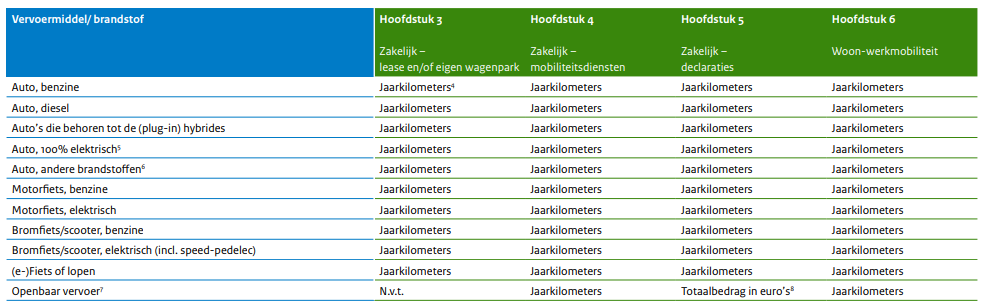
As you can see, you don't have to calculate the CO2-emissions, as governments calculate these based on annual mileage. For a detailed explanation of each component, please refer to the guide from the RVO.
4. How do I install the CO2- Is the registration stored in Exact Software?
Business and commute mileage must be recorded by mode of transportation and fuel type. This means that the following fields must be recorded for each trip:
- Mode of transportation and type of fuel (e.g., gasoline-powered car, electric car, etc.)
- Type of trip (business or commute)
- Number of kilometers (from/to and total)
There are several ways to record this, depending, of course, on how mileage is tracked:
Exact SRXP – Processing Within Expense Reporting Software
Exact SRXP is Exact's expense reporting software. Employees can easily create their own expense reports using this software. For each expense report, the available fields are expanded to align with the CO2-mandatory registration. This ensures that every expense report includes the necessary registration fields.
In the software, this works by adding additional fields to the tag fields for data entry. You can make these tags required in every employee’s expense report, ensuring that the correct information is automatically included in the report:
In Exact SRXP, you can also view the registration directly in the appropriate overview—using the Enterprise or Corporate licensing models—to make reporting easier. For more information about Exact SRXP, visit this page.
Exact Synergy – Processing Within an Expense Report Request
In Exact Synergy, employees submit their mileage reimbursement requests via a reimbursement request. This request must include the fields for mode of transportation and fuel type (with options from column 1 of the reporting overview), trip type (business or commute), and the number of kilometers. This way, employees automatically fill in the required fields when submitting their own expense reports, and you can consolidate this data into a report using a pivot table analysis or visualize it within another reporting tool.
Exact Synergy – Processing a New CO2 Reporting Request
At Alistar, we've created a new request type: the CO2 reporting request. In this request, you can add the required fields separately from the expense reports and then immediately get an overview through a pivot analysis:
- Create a CO2 Reporting Request
- Completed CO2 Reporting Request
- Overview of Requests in Game Analysis
We obtained the information in this blog from the guide from the Netherlands Enterprise Agency (RVO).
Want to know more?
Want to get started on your own with the CO2 reporting requirement, or would you like our advice? Contact Tim—he’d be happy to help you figure it out!

Tim Kraan