
The Digimeter Report: A Look at Digital Trends in Flanders
Every year, imec publishes the Digimeter Report, a comprehensive analysis of digital trends in Flanders. This report examines how Flemish people interact with technology, media, and connectivity. It explores the adoption and use of digital applications and assesses attitudes toward technological innovations. The 2024 edition shows strong growth in the use of artificial intelligence (AI), but also highlights the concerns and challenges associated with it.
The Explosive Growth of AI Adoption
2023 was the year in which generative AI rapidly gained widespread popularity. The speed of adoption surpassed that of popular technologies such as TikTok and Netflix. While these platforms took several years to reach a broad audience, AI applications such as ChatGPT managed to achieve this in just one year.
The Digimeter report confirms this breakthrough: 93% of Flemish people are familiar with AI (+3%), 71% (+14%) say they can explain it, and 45% (+11%) actively use generative AI. Among young adults, this figure is even higher: 68% of 18- to 24-year-olds use AI regularly, and among 25- to 34-year-olds, the figure is 46%.
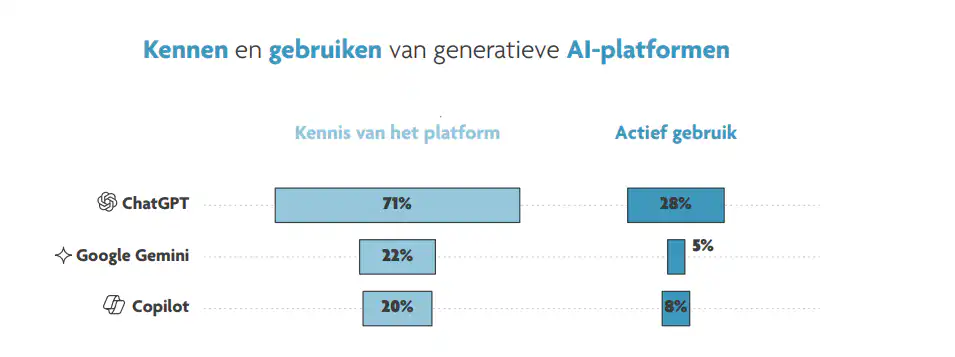
ChatGPT remains the most popular AI tool, with 28% monthly users. Copilot comes in second place with 8%, and Google Gemini ranks third with 5%.
The unprecedented speed of this adoption highlights the enormous potential of AI, but it also raises new questions and challenges.
From Experimentation to Targeted Use of AI
Many AI users are still in the exploration phase. 59% of AI users—or 29% of Flemish people—are experimenting with AI to discover what is possible. However, that proportion is declining, while habitual and purposeful use is increasing. For 28% of Flemish residents, this experimentation has now translated into regular AI use, both for personal purposes (27%) and for work (21%) or studies (14%).
Within the group of active users, we are seeing a further shift. 43% uses AI for professional tasks, while 28% uses AI for educational or study-related applications. The increase is particularly striking among students. 72% of Flemish students use generative AI, 12% of whom use it daily.
Still, the report shows that not everyone uses AI with the same level of critical thinking. Only 57% of users ask multiple questions or vary their prompts, and 53% verify the accuracy of the generated content using other sources. Only 18% explicitly cite sources when using AI.
This underscores the need for media literacy and AI literacy, so that AI is used in a thoughtful and appropriate manner.
The AI Paradox: Curiosity Versus Concern
The Flemish population has mixed feelings about AI. On the one hand, enthusiasm is growing: 77% of Flemish people are impressed by AI (+8%), 65% are curious (+4%), and 61% want to learn more about it (+4%). More than half believe that AI can help people work faster and more efficiently (53%, +5%), and 31% think that AI will improve quality of life.
At the same time, concerns are growing. 73% of Flemish people fear the negative impact of AI (+9%). 82% is concerned about the spread of misinformation (+11%), while 74% fears that AI-generated content will become indistinguishable from human creations (+10%). 62% is concerned about privacy, and 58% fears that the distinction between humans and chatbots will disappear during conversations.
It is striking that fear of job loss due to AI remains stable at 35%, while other concerns are on the rise.
This suggests that the perception of AI is gradually shifting from a threat to employment to a broader societal debate about reliability and ethics.
From Unknown and Unloved to Diverging Views on AI
Until the end of 2022, AI was an abstract concept for most Flemish people. That year, 54% had no opinion or a neutral opinion about AI, while 36% had a positive opinion and only 10% had a negative one. The introduction of ChatGPT made AI tangible and led to opinions forming more quickly.
In 2023, we saw a clear polarization. 27% of the Flemish population became convinced AI optimists, while 21% joined the ranks of the AI pessimists. The largest group, 51%, remained undecided. In 2024, the proportion of undecided voters fell further to 45% (-6%), while both camps grew. The AI-positive camp is growing faster (32%, +5%) than the AI-pessimistic camp (23%, +2%).
The majority, therefore, is still torn between curiosity and concern, weighing the appeal of AI against its potential risks.
The Digital Divide: AI as an Additional Dimension
AI not only brings opportunities, but also creates new inequalities. Digimeter 2024 highlights an additional dimension of the digital divide: efficiency.
- Admission: 97% of Flemish residents use the internet weekly, but 18% cannot afford better fixed or mobile internet service. Only 8% have access to a premium AI application, which contributes to inequality in AI use.
- Skills: Users of generative AI are significantly more skilled: 63% know how AI can make work more efficient, compared to only 13% of non-users. In addition, 36% of working or studying Flemish people need AI training.
- Attitude: AI acceptance varies by income group: among high-income earners, 44% have a positive view, while among low-income earners, 25% tend to view AI negatively. Employers and schools play a role in AI acceptance, but only 23% of Flemish residents feel encouraged to use AI.
- Efficiency: 53% believe that AI makes work more efficient (+5%), but only 28% know how to use generative AI effectively. 83% of active AI users experience efficiency gains, compared to only 40% of non-users.
These figures show that AI is not just a technological trend, but also a factor that can either exacerbate or reduce social and economic inequalities, depending on how it is used.
Bridging the Gap: The Importance of AI Training
It is not enough to simply make AI tools available within an organization. Many employees who do not use AI on a regular basis lack an understanding of how this technology can help them work more efficiently and quickly. At the same time, active users indicate that they need more training to take full advantage of AI’s capabilities. This makes it clear that a company must invest not only in the technology itself but also in the right training programs to realize its full value.
ESCs Copilot Accelerate plays a crucial role here. It offers hands-on training for every user, from beginners to advanced users, so that they Copilot for Microsoft 365 effectively apply in their daily work. In addition, it offers sessions with experts, during which employees can ask specific questions and gain in-depth insights into the practical applications of AI.
Do you want to truly benefit from AI? Then don't just provide access to the tools—invest in training your employees with Copilot Accelerate. That's how you take the next step toward a more efficient, future-proof workplace. Discover our industry-leading Training Programs and Events and give your organization the technological edge it needs. Your future in AI starts with ESC.