Over the past few decades, e-commerce has made remarkable strides in the European economy and continues to reinvent itself despite shifts in the economic and political landscape. The “2023 European E-commerce Report,” published by E-commerce Europe and EuroCommerce, describes recent developments and trends in this e-commerce sector. In this article, we focus on the findings of this report and what they reveal about Belgium and the Netherlands
General Findings
The report opens with an overview of the European e-commerce market and reveals some notable trends. In 2022, B2C e-commerce revenue in Europe grew from €849 billion in 2021 to €899 billion in 2022, despite a changing economic and political environment. Although growth in 2022 (6%) was lower than in 2021 (12%), the sector continues to move forward and is expected to keep growing in 2023. Finally, it is difficult to estimate when and what new groundbreaking innovations will be developed that could propel the e-commerce market into even higher gear. There is also a shift in public mindset toward sustainability. For example, a growing segment of society appears to be demanding that online retailers charge consumers a fee for returning items.
In 2022, Western Europe, with 67%, was by far the largest region in terms of total B2C revenue in Europe. Southern Europe follows with just 16%. Central Europe (8%), Northern Europe (7%), and Eastern Europe (2%) account for a significantly smaller share of total B2C e-commerce revenue. In absolute figures for 2022, Western Europe generated €603 billion in online sales, Southern Europe €146 billion, and Central Europe €72 billion. Northern Europe was just behind Central Europe with €65 billion, followed by Eastern Europe with €14 billion in revenue.
In 2022, 76% of Europe’s population made at least one online purchase, indicating a decline in online shopping in several countries compared to last year. The relevant national e-commerce associations attribute this trend to rising inflation, which has made consumers more cautious about their (online) spending. Last year, Western Europe surpassed Northern Europe in the share of e-shoppers among the total number of internet users (87%).
Belgium: A Growing E-Commerce Market
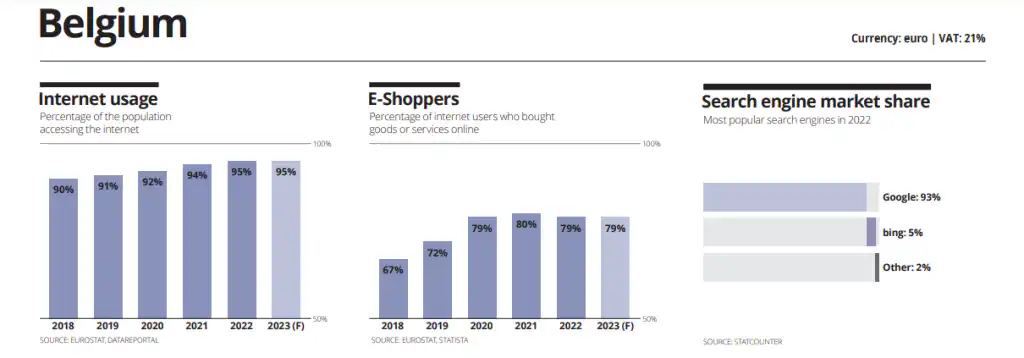
The report emphasizes that Belgium has experienced remarkable growth in the e-commerce sector in recent years. Belgian consumers are increasingly embracing online shopping, which has led to an 8% increase in revenue. The report also points out that the rise of mobile e-commerce is one of the driving forces behind this growth. In addition, we are also seeing a significant increase in sustainable thinking. For example, there is now generally greater consumer awareness of greenwashing. We can see this in the rise of, for example, circular e-business models that are increasingly focused on re-commerce. A useful indicator of whether consumers are making sustainable purchases is Ecocheques. These vouchers are very popular among Belgian consumers and are now also finding their way into e-commerce.
In Belgium, e-commerce is also being driven by improvements in the online payment infrastructure and the growing availability of e-wallets and digital payment methods. Consumers in Belgium are now able to Safe and easy online shopping to do, which has contributed to the growth of the e-commerce market.
The Netherlands: A Leading Role in Europe
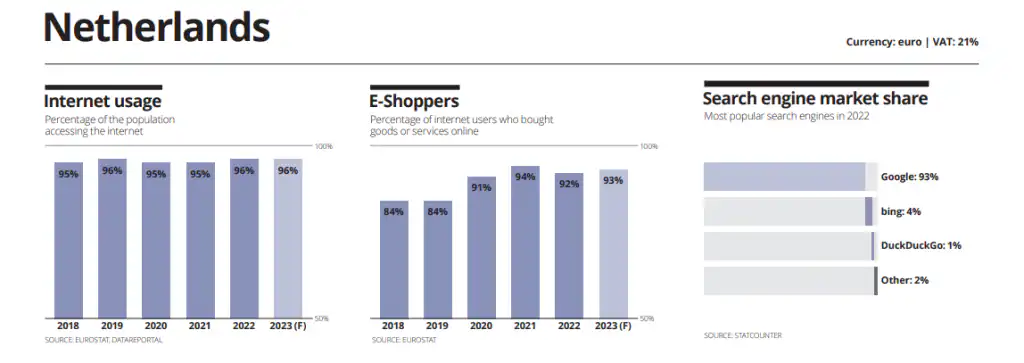
The Netherlands plays a leading role in the European e-commerce market. The report notes that Dutch consumers are known for their willingness to shop online. This has led to an annual growth of 10% in e-commerce revenue. The Netherlands is also praised for its advanced logistics networks, which ensure fast and efficient deliveries. However, since the war in Ukraine, the Netherlands has experienced a decline in consumer confidence, rising gas prices, inflation, and problems with the delivery of goods.
The Dutch e-commerce sector is being further driven by innovations such as Augmented Reality (AR) and Virtual Reality (VR) shopping experiences. Consumers in the Netherlands have access to cutting-edge technologies that allow them to view and experience products virtually before making a purchase. These e-commerce trends will eventually be adopted in Belgium as well.
Challenges and Opportunities
While the e-commerce markets in both Belgium and the Netherlands are thriving, they also present specific challenges. In Belgium, for example, efforts are still underway to improve the online payment infrastructure, while in the Netherlands, competition among e-commerce companies is fierce. Nevertheless, there remain numerous opportunities for both new and established players in the e-commerce sector in both countries.
A major challenge for e-commerce in Belgium and the Netherlands is the growing demand for sustainability. Consumers are becoming increasingly environmentally conscious and expect greener delivery and return processes. This presents opportunities for companies that strive for sustainable practices, such as efficient deliveries and greener consumption and production patterns.
Conclusion
The “2023 European E-commerce Report” offers valuable insights into the ongoing evolution of the e-commerce industry in Europe. Belgium and the Netherlands play a crucial role in this development, and the figures show that the e-commerce markets in both countries will continue to grow. In addition, businesses and consumers in Belgium and the Netherlands will continue to benefit from the innovations and opportunities that e-commerce has to offer.