Internet of Things (IoT) is a A hot topic for competitive field service organizations. Within Field Services, connected sensors are used to predict the right times for maintenance and to identify problems early on. Sensors in combination with maintenance management software keep you informed about the status and operation of each connected device. We're talking about “Connected Field Services”.
Exactly How Connected Field Services Works
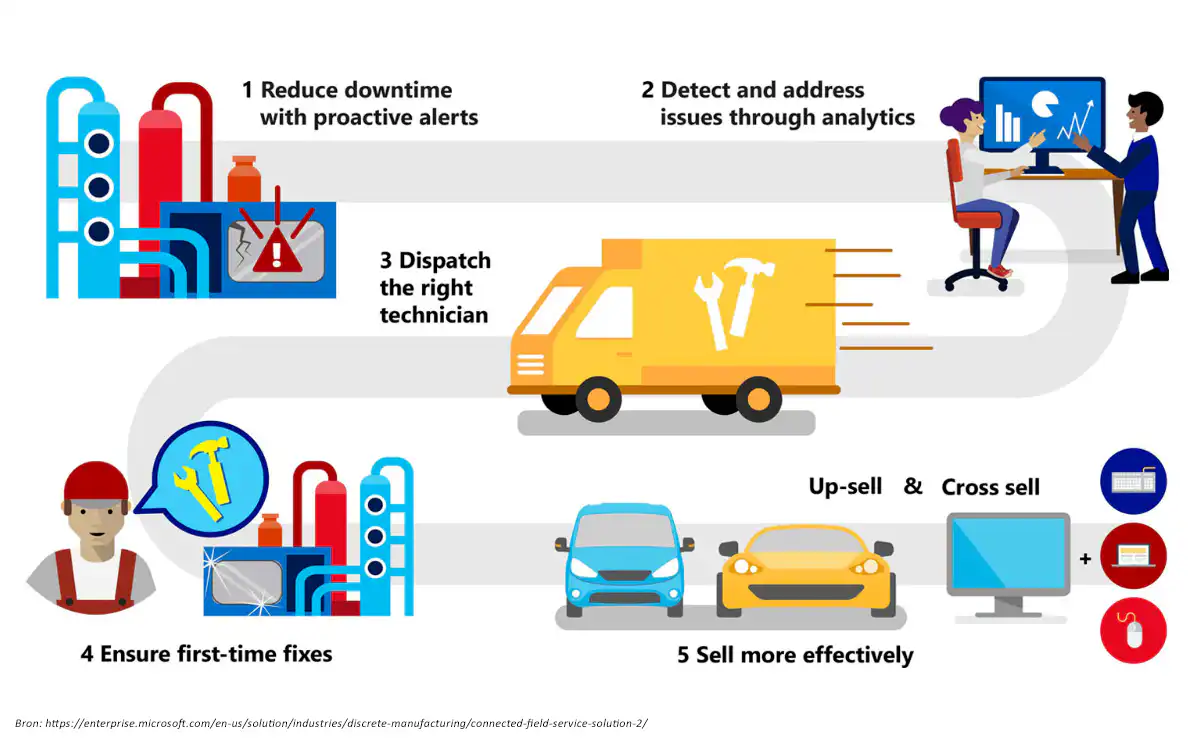
Connected Field Services therefore combines Internet of Things with a field service management system, such as Microsoft Dynamics 365 for Field Service. In a simple scenario: when a sensor detects a malfunction, the sensor sends an alert to a Azure IoT Hub. This triggers a workflow in the Field Service app from Dynamics 365. If the problem cannot be resolved remotely, a technician will be sent to the site.
Fast and accurate service, lower operating costs
The Internet of Things and Field Services is “a killer combination“.
1. With IoT, you can save on the costs of periodic inspections and immediately focus on what needs to be done, namely the necessary maintenance work itself.
For example, sensors that measure changes in the water quality of wastewater and send a signal when action is needed. Thanks to this monitoring, fewer inspections are required, leaving more time for necessary maintenance.
2. Sensors continuously monitor the equipment and systems remotely. Devices can continuously (24/7) monitor their own performance, transmit that data, and alert you if anything unusual occurs. This allows you to address a problem or minor malfunction immediately and prevent further escalation and more extensive damage.
For example, heating units and air conditioners that report maintenance issues around the clock.
3. Connected Field Services ensures that you only need to send your service technicians to the site when it's truly necessary. More and more maintenance and repairs can be performed remotely.
For example, our client Infrabel is now able to resolve numerous malfunctions without requiring a technician to go on-site. This also immediately improves safety, since technical staff do not have to travel to hazardous locations as often.
4. If a technician does have to come on-site to fix the problem, Then you can send them on their way, fully informed and equipped with the right tools or parts. The technician therefore heads out to the customer's location fully prepared to resolve the issue correctly the first time (more first-time fixes).
For example, ThyssenKrupp Elevators uses the Microsoft HoloLens to maintain elevators and repair malfunctioning ones. Thanks to the HoloLens, technicians can inspect the elevator remotely. If a broken elevator cannot be repaired remotely, the technician can first examine the problem in detail before going on-site. The technician can zoom in on specific parts of the elevator, review historical data, and thus gather all the necessary parts and tools. (more info: thyssenkrupp unveils its latest technology to transform the global elevator service industry)
5. With Connected Field Services, you can centralize information about product usage, issues, and repair history. This also results in faster and more accurate reporting and billing.