
Many CRM Projects fail because they are not used sufficiently or effectively by employees. Implementing a CRM platform means that your employees must work and think differently. People are creatures of habit and do not easily step outside their comfort zone. There’s a good chance your employees don’t see the benefits of CRM and view it as nothing more than administrative red tape and a monitoring tool. That’s why change management necessary to successfully launch the new CRM strategy and the new way of working within the organization. Change Management is about engaging your employees, communicating effectively, organizing training sessions, … .
Change Management in a CRM Project According to John Kotter’s 8-Step Model
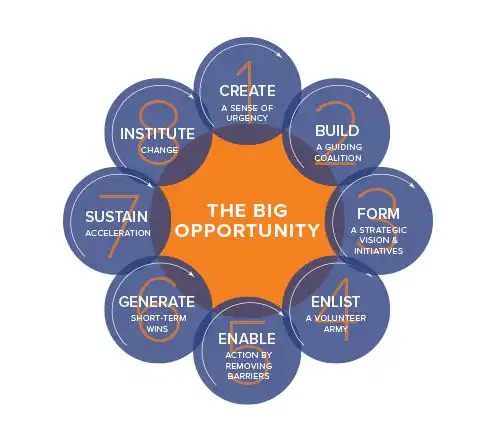
John Kotter is an American management expert. For many years, he conducted research on leaders and organizations that were trying to transform their business strategies. In 1995, J. Kotter wrote a seminal article on the eight steps to successfully implementing change in an organization.
1. Demonstrating the Need for Change
Make sure everyone in your organization sees what the current challenges Be clear about what needs to change and why. Management at 75%, in particular, must have a clear understanding that change is necessary.
For example, if you notice that sales opportunities are being lost within your company because they cannot be tracked centrally, you need to clearly demonstrate this to your salespeople using data. Only when they realize that things can’t go on this way will your salespeople be more willing to embrace change. They’ll come to see that CRM is necessary for them to do their jobs better.
2. Form a strong steering committee
Set up a stable Put together a project team that can lead and coordinate the CRM project. You should assemble this team from reliable, efficient employees—people who have the right expertise and who are trusted by everyone in the organization. This can include both managers and staff members.
For example, if CRM is to support sales and marketing processes in the future, it is important that the sales and marketing managers be represented on the steering committee. A senior sales representative whom the ‘young team’ looks up to can certainly add value as well.
3. Defining the Strategy and Vision
Customer Relationship Management is a a strategy that puts your customers first. If you clearly communicate this strategic objective and the value of customer focus to your organization, you will build support.
In addition, you should also give specific consideration to what You need to communicate to whom and on which moment. For each user profile, provide a clear answer to the question: “What’s in it for me?”.
4. Identify leaders within the organization
Identify a few ‘pioneers’ These are employees who have been strong advocates of CRM from the very beginning. They act, as it were, as ambassadors, are enthusiastic and are happy to assist their colleagues with advice and support regarding future work procedures.
These individuals can alleviate a great deal of stress and uncertainty among their colleagues, thereby preventing rumors from spreading on the CRM platform.
5. Give your employees time to learn how to use the CRM system
Don't put pressure on them, encourage your employees and set aside time and resources for trainings, workshops, … . During a training course, your employees will learn the guidelines for working effectively with CRM.
6. Achieve short-term successes
Be sure to include a a number of things that are easy to accomplish includes. These are specific goals for which CRM can quickly provide a solution, such as making customer contact information available centrally. That way, your employees will see the benefits of CRM more quickly.
Be sure to communicate these successes effectively. Don’t forget to give the individuals and/or the team responsible for these successes a ‘public’ pat on the back.
7. Consolidate improvements and continue to implement changes
Continue until the ‘First’ ultimate goal has been achieved. Take advantage of this moment to foster an environment in which everyone reflects and contributes to continuous improvement.
Moments of Success foster a positive atmosphere within the company. This is the ideal time to make an extra effort to implement other changes.
8. Embedding Changes in the Corporate Culture
Embrace the new way of thinking and acting so that people don’t fall back on the ‘old’ way of working. Just make sure this doesn’t come across as controlling.
For example, after the rollout of the CRM project, one of our clients saw a spike in CRM usage. In the weeks and months following the launch, usage gradually began to decline, and employees started falling back into old habits. It wasn’t until management took corrective action and emphasized the importance of the system that a turnaround occurred and the new way of working became firmly established.
Management must therefore promote the new way of working and use the new tools for reporting and supporting decisions.