Sustainability is a hot topic these days, and more and more companies are making an effort to document their sustainability initiatives. In this blog, we’d like to tell you what you can do with these features in Microsoft Dynamics 365 Business Central and what the benefits are.
In our previous blog post about the new features in Microsoft Dynamics 365 Business Central, we told you about the new sustainability-related features that have been added to Business Central.
New Position: Sustainability Manager
With this new role center, Microsoft makes it much easier to track sustainability activities. All relevant features can be easily accessed and managed from a single central location. This is especially useful now that more and more companies are hiring staff dedicated entirely to the company’s sustainability activities.
Real-time monitoring
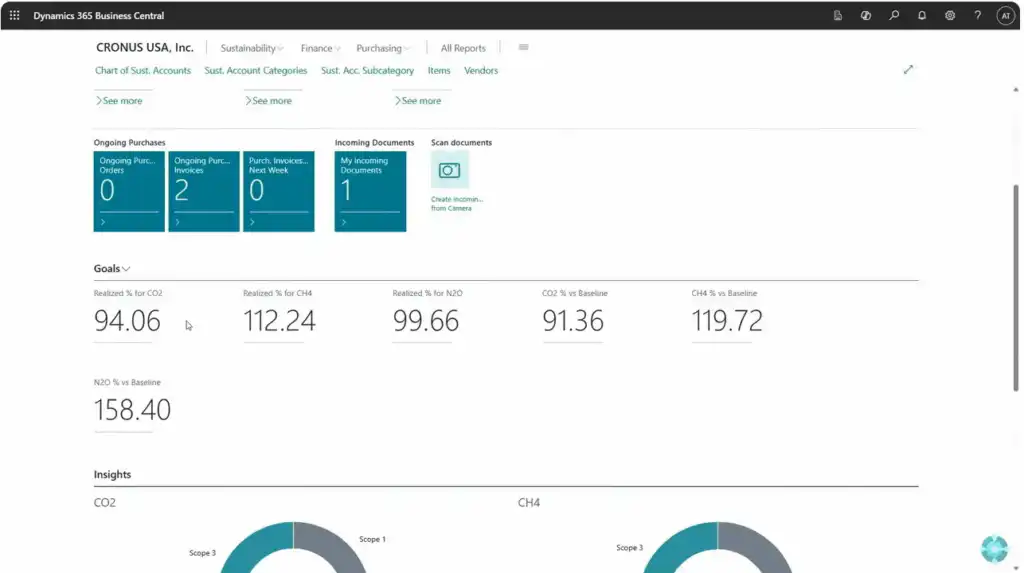
The dashboard provides quick access to key environmental statistics and compliance data. This enables managers to monitor sustainability initiatives in real time and make timely adjustments to meet regulatory requirements and business objectives.
Data-Driven Decisions
Streamlined access to data allows sustainability managers to focus on strategic decision-making and continuous improvement, which ultimately leads to more sustainable business practices and better overall organizational performance.
Understanding Emissions
The dashboard provides detailed information on greenhouse gas emissions, including charts and alerts for key metrics. This helps track and manage the organization's environmental footprint.
Support for sustainability goals
Managers can set up scorecards and goals and compare them to baseline and target values, which helps in achieving sustainability goals.
Sustainability Scorecards
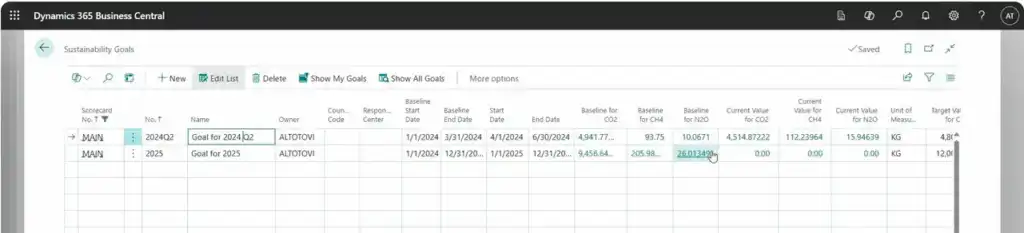
To track sustainability and add specific goals, you can use sustainability scorecards.
These goals include a baseline: a calculation of the current value and the establishment of a target value within a specified time frame. By reporting transparently on sustainability performance, you can enhance your company’s reputation and build trust with customers, investors, and other stakeholders.
Setting Emission Factors
You can set emission factors for various sources and categories of greenhouse gas emissions. This helps ensure accurate calculations of the carbon footprint.
Data Recording
Emissions data can be entered manually into sustainability scorecards or calculated automatically using built-in methods. This data is recorded in sustainability logs and purchase documents.
Calculation of Emissions
The tool can convert emissions to CO₂ equivalents using formulas. This makes it possible to use a standardized metric for different types of emissions.
Sustainability Certificates
Customers are placing increasing value on products that are better for people and the environment. It is therefore beneficial for your company to demonstrate that the products you manufacture or purchase are produced sustainably. There are several recognized organizations that issue sustainability certificates to support this. You can easily register these certificates—both for your suppliers and for the products they use—so you always have a clear overview.
If a supplier or an item has a sustainability certificate from a certifying body, you can easily record the information about the supplier or the item so that it is immediately available. Would you like to find a supplier that holds a specific sustainability certificate? If so, you can filter by this criterion.
You can create sustainability certificates with the following details:
- Name
- Area
- Default
- Publisher
- Value
Emission fees
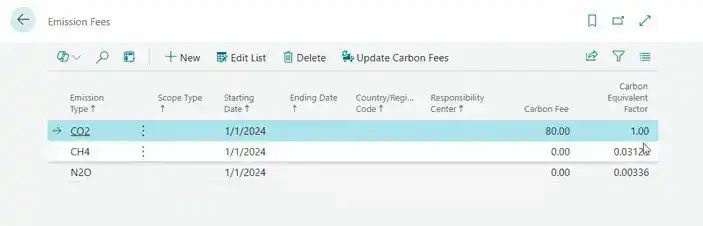
Emission fees allow you to set carbon fees and carbon-equivalent factors for each emission type. Emission fees are charges that companies pay to offset the environmental impact of their activities.
Consider:
- Carbon emissions from transportation
- Pollution from manufacturing processes
- Energy consumption that contributes to CO₂ emissions
In Business Central, these costs can be linked to specific transactions or processes so that they are automatically calculated and processed.