

What is marketing automation? Marketing automation involves automating tasks that guide (potential) customers through the purchasing process. The goal is to improve conversion rates and increase the quality of leads. Marketing automation is particularly effective when combined with inbound marketing efforts (where potential customers from your target audience find you on their own—for example, through your website—without you having to initiate the conversation through traditional channels such as ads, mass emails, cold calling, etc.).
In marketing automation, we distinguish three pillars:
- Creating Customer Profiles
- Personalization of marketing campaign flows
- Prioritizing Sales Leads
Creating Customer Profiles
Imagine the following situation: a new visitor arrives anonymously on your website. Through the web tracking The marketing automation tool automatically creates an anonymous user. Everything the visitor subsequently views or does is tracked and grouped under that same (anonymous) user. As soon as this anonymous user reveals information about themselves—for example, by filling out a form—you have personal data. All data (behavioral and personal data, personal preferences, etc.) is linked to the same user, and in this way, you build a digital profilel from your (potential) customer.
User Profiling is one of the fundamentals of marketing automation.
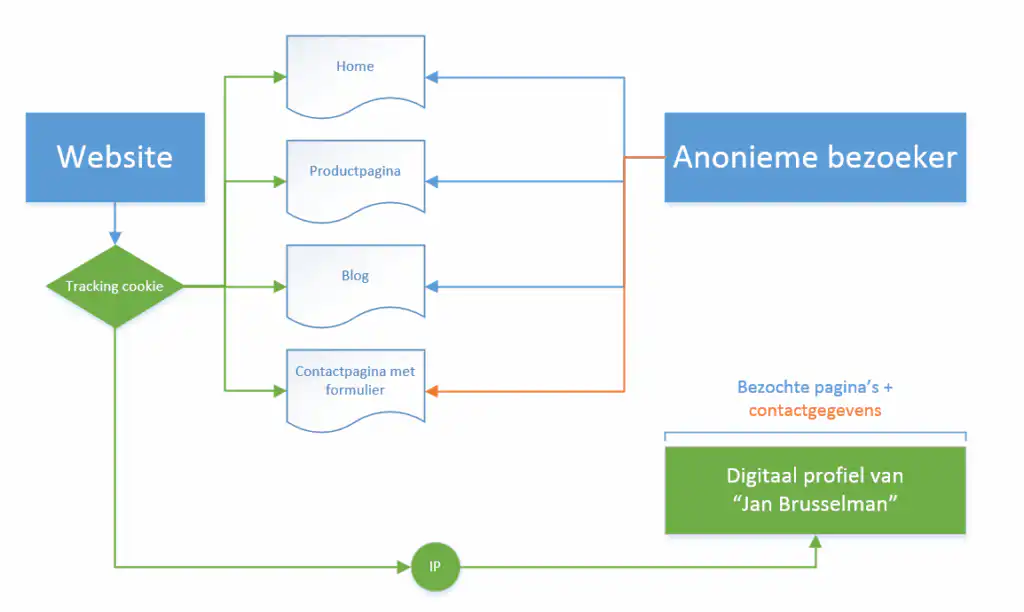
Personalization of marketing campaign flows
As a marketer, you develop the strategic approach to build customer engagement through marketing communications and inspire them to take action. With marketing automation software, you configure the campaign flow. You set the starting point or trigger yourself—for example, after downloading a white paper, registering for an event, requesting a trial account, requesting a quote, and so on.
From this point on, the entire campaign flow unfolds automatically and is tailored to the customer, based on a number of conditions in the profile data and the customer’s subsequent responses to the content they receive.
Examples of lead nurturing campaigns
- 30-day trial account for Microsoft Dynamics CRM Online: After setting up your trial account, you'll automatically receive regular email messages with tips and resources to help you make the most of your trial period.
- On MyAsics.com Runners enter their fitness goals, and the system automatically generates a plan that maps out the path to success. After that, automated, personalized coaching for each runner begins via a daily email.
- Content Downloads: A popular technique you'll find on many websites is the content download. For example, you download a white paper, and then over a certain period of time, you receive a series of emails that were prepared in advance. The next email you receive depends on your response to the previous one.
Prioritizing Sales Leads
In a solution sales context You can use marketing automation to improve lead quality and identify which leads are ready to buy. That’s why we assign a score to each of the lead’s activities (lead scoring). By using lead scoring, you can work toward generating better-qualified leads. The basic premise here is that interested leads will seek out information and effectively review the information provided.
Lead Scoring Example:
| Visit the product page: | 5 points |
| View a specific blog post | 3 points |
| Download the white paper | 10 points |
| Total | 18 points |
For leads with a relatively high score, we consider it highly likely that there is genuine interest. These leads are flagged for your sales team for further follow-up. Leads with a relatively low score will remain under the marketing department’s purview for the time being.
What are the main benefits of marketing automation?
- You'll get to know your (potential) customers better, identify their needs and preferences more effectively, and tailor your marketing activities accordingly.
- You’re building a marketing database with clear profiles. (CRM systems are sometimes only used once a lead is picked up by the sales department, but what happens to all the information from the leads that haven’t been qualified yet?)
- Segmentation options based on both behavior and profile, allowing you to communicate in a targeted manner.
- Marketing and sales can be better aligned, which will enable them to work in a much more results-oriented and efficient manner.
- Better insight into lead quality. Lead scoring gives you a better understanding of how willing (potential) customers are to purchase a product or service.
- The ability to personalize marketing campaigns leads to greater engagement (see higher open rates and click-through rates).
- You’ll save time and money through automation: tracking visitor behavior, running automated email campaigns, qualifying leads, …
Even after the sale, marketing automation can help you maintain your relationship with your customers. By continuing to track your customers’ digital activities, you’ll get to know them even better. You can use these insights to steer the conversation and create new opportunities.


