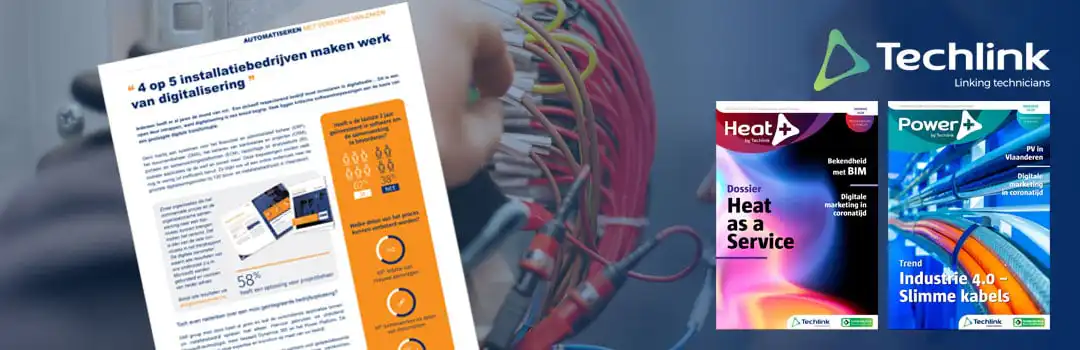
Techlink Power+ and Techlink Heat+ – November 2020
Everyone has been talking about it for years. Any self-respecting company must invest in digitalization. This is stating the obvious, because digitalization is a broad concept. As our trend report “The Digital Barometer“, critical software applications are often the foundation of a successful digital transformation.
Also in the magazines of the Confederatie Bouw – Techlink Power+ and Heat+ – Alistar recently published an article on this topic, addressing installation companies specializing in specialized technologies and HVAC, respectively. In this blog post, we’ll take a closer look at common arguments for and against pursuing digital transformation.
We’ve gathered 8 quotes from everyday practice that show that such applications are still underutilized (or used inefficiently), even by installation companies. Perhaps you can relate to this?
1. Increase Efficiency
We're doing way too much duplicate work.
And by having to enter the same data into different systems, we’re wasting time and money. However, we could generate more business with those same people. So we need to improve our efficiency.
2. Minimizing Errors
We make too many mistakes.
There are various versions of calculation templates in use; everyone has their own version, and as a result, certain calculation errors keep cropping up. In addition, updating a quote takes too much time. It should be possible to do this with the push of a button.
3. Transparent processes
We don't have a clear overview of our orders.
When an order comes in, we have an incredible amount of work ordering everything from our suppliers. We have no visibility into delivery times, so we end up ordering too quickly… which in turn leaves us with excess inventory. Often, the prices are no longer accurate by the time we make our purchases, so we either cut into our margin or can’t offer competitive enough prices, causing us to lose business.
4. Greater customer satisfaction
We're billing too late.
It takes ages before we can bill for our service jobs. The written work orders are left in the vans or are barely legible. We have to wait too long to get paid, and the customer is dissatisfied because they receive their invoice too late.
5. Centralize Information
Important documents are being lost.
We don't know what to do with all the technical documentation, certificates, plans, and the like anymore. The cabinets are overflowing, and even a cat couldn't find its kittens on the file server anymore…
6. Proactive Management
We don't have accurate figures.
We don't have the data we need to make strategic decisions. Every month, we spend days compiling reports to gain the necessary insights, because the information is scattered all over the place.
7. User-friendly technology
Our system is outdated.
Our system isn’t just outdated… it’s no longer even supported, and we have too many silos within our company. Our younger colleagues say we’re working with outdated solutions that aren’t user-friendly or intuitive. The average technician in 2020 has grown up with a cell phone in hand, so why shouldn’t they be able to fill out a digital work order?
8. Professional Support
We don't trust our IT partner.
We no longer have confidence in the future of the software we are using and/or in the IT partner that has been supporting us so far.
An integrated approach
And we could go on like this for a while… as I said, the arguments are well known.
All of this points to the need for an integrated approach and an integrated solution. Alistar has been championing this approach for years, enabling the various applications within your installation company to communicate with one another. To achieve this, we use exclusively Microsoft technology—specifically, Dynamics 365 in combination with the Power Platform.
Microsoft Dynamics 365 Business Central is a globally used ERP system with more than hundreds of thousands of users. Thanks to our expertise and know-how, we tailor it to your company’s needs.
Since, in 2020, it’s no longer realistic for an ERP partner to handle or build everything in-house, we surround ourselves with professional partners who provide specialized sub-solutions. These include graphical planning tools, mobile work orders, scanning, document archiving, etc.
Yeah, but an integrated solution costs a fortune!
This is one of the most common arguments for not investing in the rollout of a new ERP system at this time.
Does this sound familiar? If so, try doing this simple calculation yourself:
What if my people every day 12 minutes save time (for the reasons mentioned above)? This amounts to 1 hour per week.
Suppose a company has 50 employees; in that case, we're talking about 50 hours per week.
Based on a 38-hour workweek, this means 1.32 FTE.
If one FTE costs the company approximately €60,000 per year, that comes to €79,200 per year, or € 396.000 in 5 years…
You can develop the rationale for your company yourself. Keep in mind that a time savings of 12 minutes per day per employee is not an exaggeration—you can safely double that figure.
Why not take a moment to think about a well-integrated business solution?
You have been building your business for decades, and your processes have been refined time and again over the years. All of this must be translated into a digital format in a well-thought-out manner.
In short, it's more than worth the investment!
Testimonials from Our Customers
To operate more efficiently and in a more customer-focused manner, the security company Seris Technology wanted to further digitize its operations. The old ERP system was replaced by Microsoft Dynamics and integrated with other applications, so that employees can work more easily and efficiently.
Today, Seris looks back on a successful change project with Alistar that delivered the comprehensive solution Gservice implemented, fully integrated with, among other things,. SharePoint and Teams.
Thanks to this system, we can work more efficiently, our employees can focus on customer service, and ultimately, we achieve higher customer satisfaction. That is the true return on investment.
Christophe Voets, Director, Seris Technology