
Most organizations today make the same mistake when it comes to AI. They start by asking, “Which AI tool are we going to implement?” Copilot, chatbots, predictive analytics, and automation quickly become the focus of the discussion. But that’s actually the wrong way to start.
As soon as you start with technology, something predictable happens. Ideas get stuck in the experimental phase, use cases feel forced, and the real business impact fails to materialize. Not because AI doesn't work, but because you jump to solutions too soon.
AI is not an implementation process. It is a process of discovery.
Organizations that do succeed with AI start from a different place—not from tools, but from their own operations and challenges. They first ask themselves a different question: Where is the greatest friction in our processes, and how can AI create value there?
That shift may seem small, but it changes everything. AI is no longer just an IT project, but an innovation process.
And that’s exactly where the problem lies for many companies. They have ideas, but lack direction. They see opportunities, but can’t set priorities. They experiment, but without a clear link to business value. As a result, many AI initiatives get stuck in the exploratory phase, long before they make a real impact.
Why “Discovering AI” Is So Difficult
The paradox of AI is that everyone recognizes its potential, but few organizations know where to start. AI is both widely applicable and difficult to grasp. For business stakeholders, it often remains abstract, making it difficult to determine what is relevant and what is not.
Without structure, this almost automatically leads to fragmentation. Brainstorming sessions remain vague, ideas have no one to take ownership of them, and discussions get stuck at the level of “we need to do something with AI.” There’s a lot of energy, but little focus.
The Missing Link: Structure in Innovation
This is where the difference lies between experimentation and true innovation. Innovation requires structure—not to limit creativity, but precisely to focus it on business impact.
An AI Discovery approach brings that structure to the process. It builds on your existing processes and pain points and makes AI capabilities tangible. Ideas are then systematically translated into concrete use cases, which you can evaluate together in terms of impact and feasibility.
Instead of guessing where AI can add value, it becomes an exercise in making choices based on insights. AI is no longer something abstract, but something you can use to make targeted decisions.
From Abstract AI to Concrete Use Cases
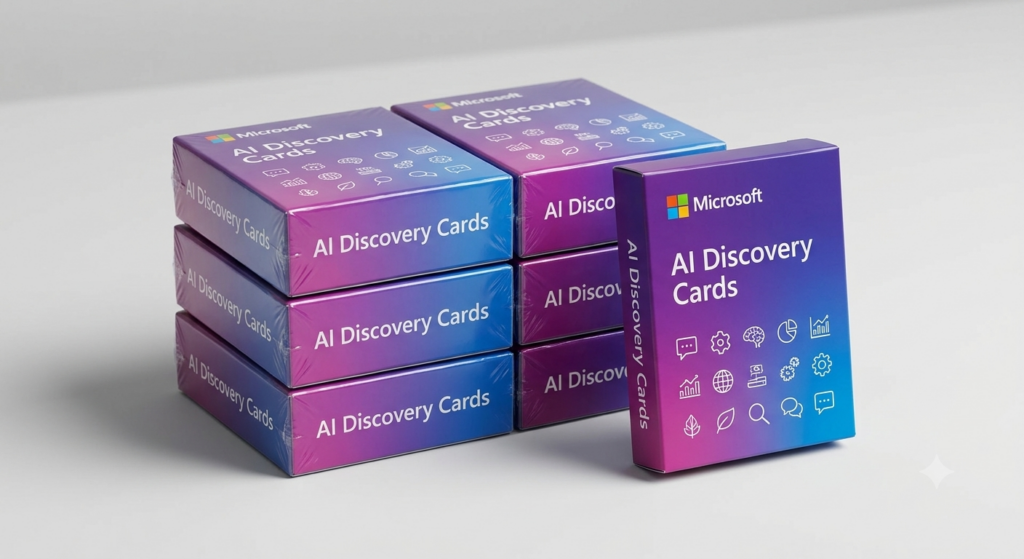
An important tool in that process is working with Microsoft AI Discovery Cards. These cards help break down AI into understandable building blocks. They link AI capabilities directly to recognizable business problems and make it possible to quickly test ideas.
That is precisely why they serve as a bridge between business and IT. They ensure that everyone is included in the discussion, regardless of their technical background, and help teams reach shared insights more quickly.
The result isn’t a list of random ideas, but a set of clear use cases, well-considered decisions, and an initial path toward implementation. You move from inspiration to action.
Innovation is a process
This aligns perfectly with what we at Alistar observe in organizations that are truly making progress with AI. They don’t treat AI as a technological issue, but as part of a broader innovation strategy.
Within the Alistar Triple I Model Does that fall under Innovate. The focus here is on identifying opportunities, aligning stakeholders, and translating ideas into feasible initiatives. Not as a one-time exercise, but as a structured way of working that helps organizations continue to evolve.
The Real Shift: From Building to Understanding
Perhaps this is the most important shift: successful AI projects don't start with building, but with understanding.
Understanding where value lies. Understanding where friction lies. Understanding where change is needed. Without that insight, any AI implementation remains a gamble, no matter how advanced the technology may be.
Conclusion
AI has the potential to fundamentally transform your organization, but only if you approach it the right way. Not by implementing it faster, but by exploring it more intelligently. Those who approach AI as a journey of discovery lay the foundation for sustainable innovation—not through isolated experiments, but through targeted initiatives that effectively create value.
Want to find out where AI can really make an impact in your organization? Check out all the information about our Innovate Get started and request a consultation.
Curious to find out what else AI can do for your content strategy?
The combination of DatoCMS and MCP demonstrates how AI is evolving from an assistant to an active contributor within content processes. Would you like to explore what this means for your organization? We’d be happy to help you develop the right architecture, governance, and implementation strategy.
👉 Schedule a no-obligation consultation
Or discover how we help organizations build scalable digital experiences.