


With the right software and IT solutions, you can organize your processes more efficiently, respond more quickly to changes, and provide your customers with the service they expect.
Technology brings efficiency and capability

Does your software landscape resemble a collection of islands? Many maritime companies use separate software for each department, which results in a lot of time being wasted on manual data entry.
Are you still using outdated business software, non-integrated software packages, or paper-based calculations? Flexibly automate your business processes with Microsoft Dynamics 365 Business Central and our maritime extensions for:

Our experts understand your problems and challenges and help your company achieve its business goals with the right IT solutions.
From Power BI to Power Automate and from Teams to Security: Alistar takes care of everything for maritime companies from A to Z.

Our experienced consultants speak your language and have years of experience in the maritime industry.


Although companies operating in the maritime sector share certain similarities, every maritime company is unique. Find out which software is right for your maritime company.
Maritime service and engineering companies need an ERP system that brings together sales, purchasing, materials, projects, and finance in a single environment. This ensures that the entire process—from quotation to execution and invoicing—runs smoothly without separate systems or duplicate data entry. Microsoft Dynamics 365 Business Central is a great fit for this. In this cloud-based ERP (SaaS), you can link costs, hours, and materials directly to projects and tasks. During execution, you can see the financial status of a job and the status of ordered parts. For technical services, where you rely heavily on materials and suppliers, this offers significant benefits.
A good ERP system for the maritime sector is also ready for the future. Business Central manages customer, supplier, product, and project data in one central location. Employees in the office, in the workshop, or on board can work with the same up-to-date information from any location. In addition, Business Central is evolving into a platform where Copilot, AI agents, and automated workflows increasingly support or even perform tasks on their own. This makes it a strong choice for maritime companies that want to gain control over their projects now and prepare for the next step in automation.
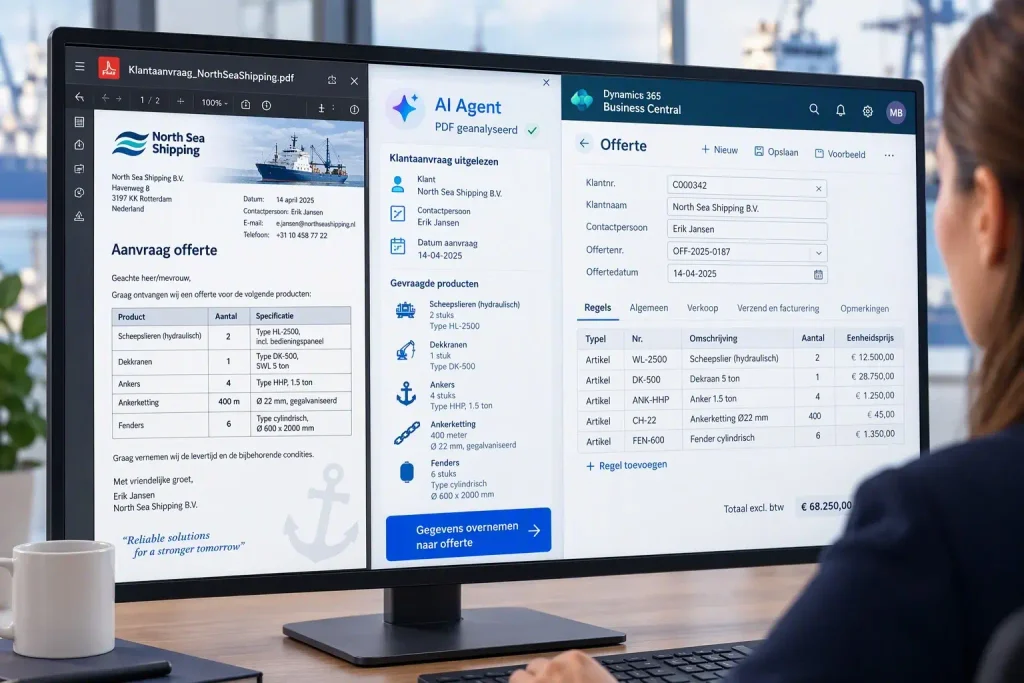
Microsoft Dynamics 365 Business Central is a cloud-based ERP (SaaS) solution that enables maritime companies to manage sales, purchasing, materials, projects, and finances in a single system, from quote to invoice. Costs, hours, and materials are directly linked to projects. This allows you to see, even while the project is in progress, how it is performing financially and what the status of ordered parts is.
Customer, supplier, product, and project data are stored in a single central location that can be accessed from anywhere. With Copilot, AI agents, and automated workflows, Business Central is also evolving into a platform that increasingly supports or performs tasks on its own.
Manually entering orders and invoices slows down processes and increases the risk of errors.
Paper lists and separate Excel files make it difficult to see up-to-date data.
Manual counts lead to inaccurate inventory levels and unexpected shortages.
Without integrated systems, it takes a lot of time to plan dredging or production projects.
Data is often entered multiple times into different systems, which leads to errors.
Manual processes make it difficult to quickly determine where materials or costs are going.
From tugboat operations and offshore to shipbuilding: with integrated IT solutions, you can work more efficiently, with greater control and less manual labor.
Towing and salvage operations are complex, dynamic, and require absolute precision. From contracting and billing to scheduling, crew management, safety, and maintenance—you need a solution that brings it all together.
TugVision365 is built on Microsoft Dynamics 365 Business Central and designed specifically for towing and salvage companies. It helps you streamline processes, simplify compliance, and increase your fleet’s efficiency—all within a single, integrated ERP system.

"We now have real-time insight into our business management and operations, both onshore and offshore, across all our geographic locations..."
KOTUG is an innovative and leading maritime family-owned company that provides towing and maritime services worldwide, with its headquarters located in Rotterdam.

Cyberattacks are no longer limited to laptops and servers. As more and more physical systems become connected, your digital footprint is also growing

Implementing AI is relatively simple. Determining where AI actually adds value in your organization is much more difficult. That’s why you should
Curious about what digital transformation can do for your manufacturing company? Contact our expert and discover the possibilities.

An ERP system for maritime engineering and service companies integrates the commercial, operational, and financial processes related to projects and services.
Think about sales, quotes, projects, purchasing, materials, suppliers, time tracking, service, billing, and financial administration.
For companies that perform technical work on board, on-site, or in a workshop, the coherence between these processes is particularly important. For example, a sales order does not stand alone: it may require purchasing materials, assigning employees, performing work, and recording costs before an invoice can be issued.
Microsoft Dynamics 365 Business Central provides a single, centralized ERP environment for this purpose. Depending on the organization, Business Central can be expanded or integrated with solutions for areas such as project management, service, planning, document management, and reporting.
This makes it possible to tailor the ERP landscape to the actual processes of a maritime engineering company, rather than adapting existing processes to a single off-the-shelf package.
For maritime service and engineering companies, the value of Business Central lies primarily in connecting processes that would otherwise easily operate in isolation.
From Quote to Execution and Invoicing
Sales, purchasing, materials, projects, and financial processing can all be managed from the same platform. This provides a better overview of the entire process, from request to invoice.
Keeping Track of Projects and Tasks
Costs, revenues, materials, and hours can be linked to projects and tasks. This provides better insight into financial progress during project execution.
Connecting Procurement and Material Flows
Technical services often depend on parts and materials. By linking purchasing, suppliers, items, and projects, it becomes easier to see what has been ordered for a particular job and what its status is.
A single central source of information
Customer, supplier, product, and project data are managed centrally. As a result, data needs to be re-entered less often.
Working in the Cloud
Business Central is a SaaS solution. This allows employees to work with the same centralized business information from different locations.
Automation and AI
Business Central is also continuing to evolve into a platform where Copilot, AI agents, and automated workflows can support or perform tasks.
Depending on the type of organization, Business Central can be used for, among other things:
Not every maritime engineering company needs the same setup. For example, a spare-parts supplier has different processes than a company that performs maintenance projects on board or builds technical installations.
That is precisely why the combination of Standard ERP functionality, industry-specific configuration, extensions, and integrations important.
With Business Central, an offshore company can automate financial accounting, contracts, dispatching, projects, crew scheduling, maintenance, and QHSE, among other things. All departments work in a single environment using the same data, which eliminates the need for duplicate work.
In Business Central, with Alistar’s maritime extensions, you can manage crew scheduling and maintenance in the same system as projects and finances. This allows you to see immediately how scheduling, deployment, and costs are interrelated.
Yes. QHSE (quality, health, safety, and environment) is part of Alistar’s integrated offshore solution on Microsoft Dynamics 365. Because quality and safety data are stored in the same system as the operations, it’s easier to record, track, and document them.
With a cloud-based ERP system like Business Central, the office, fleet, and offshore locations all have access to the same up-to-date information. The Maritime service provider KOTUG now has real-time insight into its operations, both onshore and offshore and in all geographic locations.
In the field of maritime engineering, in particular, sales and implementation are closely intertwined.
A customer inquiry can lead to a quote, after which parts must be requested or ordered from various suppliers. Next, materials are delivered, work is performed, and finally, the products and services provided are invoiced.
If these steps take place in separate systems, it becomes more difficult to quickly answer questions such as:
Business Central can bring these information flows together within a single business environment.
A good example in the maritime sector is Bokort Maritime Trading Services & Forwarding. There, Sales quotes, purchasing, logistics, and invoicing linked to each other within Business Central. Linked purchase documents are available for each sales order, and delivery dates and incoming goods are tracked
Yes. Business Central includes functionality for project-based business processes. The configuration required depends, among other things, on how projects, materials, hours, purchasing, and invoicing are organized within the organization.
Yes. Business Central can serve as the central ERP layer for areas such as customers, projects, materials, purchasing, finance, and invoicing. For specialized maintenance or service processes, additional functionality or an integration with a specialized system can be used.
Yes. Business Central can serve as the central ERP layer for areas such as customers, projects, materials, purchasing, finance, and invoicing. For specialized maintenance or service processes, additional functionality or an integration with a specialized system can be used.
Yes. Business Central is evolving to support Copilot, AI agents, and process automation. Recurring administrative processes—such as those related to orders, purchasing, invoices, and data processing—are particularly promising areas of application.
In addition to Business Central, Alistar also offers Power BI, Power Automate, Microsoft Teams, and security and CRM solutions. In this way, Alistar supports maritime companies from start to finish.
