
AI has been gaining momentum for some time now. New tools, updates, and capabilities are emerging every day. Think of smart email summaries, AI-generated visuals, automated reports, or bots that answer customer questions before your team even sees them. Artificial intelligence is popping up in just about every digital application, often without us even noticing.
Organizations are feeling the pressure to do this “to have something to do with it”. Not just because competitors are touting it, but because it’s becoming increasingly clear: AI isn’t just hype. It’s fundamentally changing the way we work, make decisions, and create value.
But then comes the key question: How do you actually get started with this as an organization? How do you ensure that AI doesn’t become just a side project led by one enthusiastic colleague, but rather a strategic part of your operations?
Why You Shouldn't Just Jump Right Into AI
AI is not a plug-and-play technology. You can’t just say, “Starting tomorrow, we’re going to use AI.” Without a vision, support, or guidance, AI initiatives quickly get bogged down in noncommittal experiments. A pilot here, a prompt there… but no lasting impact.
The challenge isn't what AI can do all sorts of things—that’s been discussed enough already. The real challenge is: What can AI do for your organization?
That calls for a different approach. And that approach is based on three key pillars:
- Technology: Do you have the right infrastructure, tools, and data quality?
- Processes: Which workflows can be made more efficient, faster, or smarter with AI?
- People: Is there enough support and sufficient knowledge to use and embrace it?
AI affects not only your IT environment, but also your Work style and your organizational culture. Without a well-thought-out approach, you run the risk that AI will cause frustration rather than progress.
That is why a structured approach is essential.
And that's exactly where the Gartner's AI Opportunity Radar Featured: A model that helps organizations shape their AI strategy, set priorities, and make choices that deliver real value.
What is the AI Opportunity Radar?
The AI Opportunity Radar is a strategic model that helps organizations identify, evaluate, and prioritize of AI applications. It provides a visual framework for clearly identifying where and how AI can add value, taking into account technological maturity, impact on the organization, and feasibility of implementation.
In this way, the AI Opportunity Radar helps you make informed decisions and integrate AI into your organization step by step, in a thoughtful and targeted manner, for maximum impact.
The model maps out AI opportunities along two axes:
- Horizontal: from Everyday AI, applications that can be deployed quickly and easily, up to Game-Changing AI, strategic innovations that can fundamentally transform your operations.
- Vertical: from internal processes, such as administration, finance, or HR, to customer-focused applications, such as sales, marketing, or customer service.
In addition, the model uses three rings that indicate the feasibility of implementation:
- Inner ring: The technology is available, costs are low, and integration is easy.
- Middle ring: requires more investment and effort, but also offers greater strategic potential.
- Outer ring: complex and far-reaching, but with the potential to fundamentally transform your market or business model.
By mapping out AI opportunities in this way, it quickly becomes clear where you should start, and which initiatives you should postpone or prepare for.
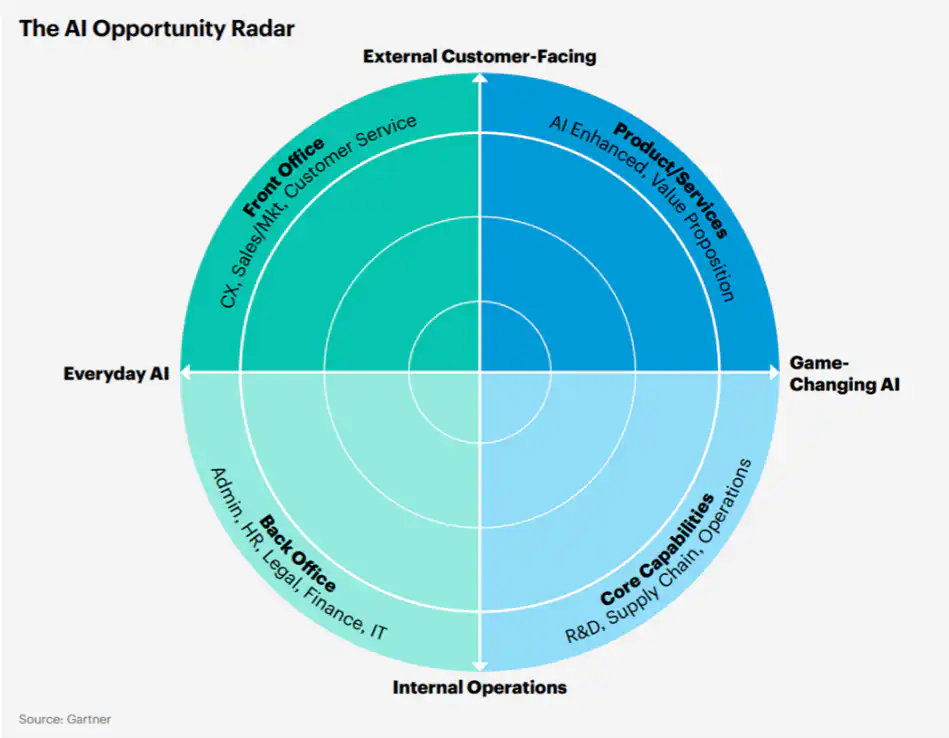
Source: Gartner, 2024 – Map Your AI Use Cases by Opportunity
Where are your AI opportunities?
The AI Opportunity Radar not only helps you make sense of the AI landscape, but also helps you discover where the first and most valuable opportunities lie within your organization. Each area on the radar represents a different type of activity, each with its own pace, impact, and complexity.
We identify four key areas where AI is already delivering tangible value today. Below, we explain these areas using concrete examples and describe how Microsoft Copilot or custom solutions can make a difference in each of them.
1. Back office – HR, finance, legal, IT
The back office is often where you’ll find the most feasible and quickly implementable AI applications. These involve repetitive, administrative tasks that require a lot of time and focus—the perfect area for AI support.
Consider:
- HR teams that use automated tools to generate job postings,
- finance departments that summarize reports or analyses using prompts,
- IT staff who can search internal documentation more quickly using natural language.
Thanks to Copilot for Microsoft 365, which integrates directly with tools such as Word, Excel, Outlook, and Teams, makes it exceptionally easy to get started. This allows you to boost productivity without the need for customization or complex projects.
2. Front office – Sales, marketing, customer service
In customer-focused departments, AI helps make interactions with your target audience more personalized and efficient.
For example, the sales department uses AI to quickly analyze customer data, prepare conversation scripts, or automatically generate follow-up emails. Marketing uses AI for content creation, target audience segmentation, and campaign optimization. Customer service departments are increasingly implementing AI chatbots that independently answer questions or handle simple requests.
Copilot for Dynamics 365 integrates AI into your CRM, marketing automation, and customer service processes for smarter, faster interactions that truly add value.
3. Core capabilities – Supply chain, R&D, operations
These core processes hold the greatest strategic potential. Here, we are talking about Game-Changing AI: applications that can fundamentally strengthen your organization through in-depth automation or predictive insights.
Here are a few examples:
- AI models that predict inventory levels or delivery reliability,
- optimize maintenance planning based on sensor data,
- or accelerate product development cycles using the concepts generated.
These applications are generally more complex and require a higher level of AI maturity, but they provide a competitive advantage that is difficult to match. With tools such as Copilot Studio You build custom AI solutions tailored to your critical processes and objectives.
4. Products & Services – AI in Your Offerings
In this field, AI is not an internal tool, but an integral part of your product or service. Consider:
- online stores with AI-powered recommendation systems,
- SaaS platforms that analyze and predict user behavior,
- or smart devices with built-in AI capabilities.
These applications are usually found in the outer ring of the radar: disruptive, complex, but with enormous strategic potential. Here, you often work with Custom AI solutions, built on platforms such as Azure AI, OpenAI or through specialized third-party integrations.
What is still holding companies back today?
Although the technological capabilities surrounding AI are evolving at a rapid pace, many organizations still face significant barriers to actually getting started with it.
Consider fragmented or incomplete data, the lack of a clear strategy, or employees’ reluctance due to unfamiliarity with the technology. The result? AI often gets stuck at the stage of isolated experiments or theoretical plans, without having a broad impact.
That’s a shame, because right now the first valuable applications are often within reach. To overcome those obstacles, Alistar a concrete starting point: the Copilot Readiness Assessment.
During this process:
- we analyze your Microsoft 365 environment,
- we'll assess your current level of AI maturity,
- and we identify which applications are the most feasible and valuable.
You'll receive a clear report with strategic advice, quick wins, and concrete next steps, so you can get started with AI in a well-thought-out, goal-oriented, and confident manner.
Take the next step at AI & Copilot Connect
Curious about how to apply all these insights in a practical way within your organization? During the AI & Copilot Connect webinar in September, you’ll discover how to use the AI Opportunity Radar as a compass, where to start with AI, and how to quickly create value with Microsoft 365 Copilot. We combine strategic insights with practical examples so you can confidently take your first steps toward a well-thought-out AI approach. Register for AI & Copilot Connect and be inspired by concrete applications and insights you can put to use right away.