Gaining insight into the various stakeholders and developing those relationships into more sustainable ones is a challenge for many organizations.
This article is for anyone looking for effective Tools for Stakeholder Relationship Management. Here’s an overview of the key factors to consider when making that choice. But first, let’s clarify exactly what we mean by “stakeholder relationship management.”.
What is stakeholder relationship management, and who should care about it?
Stakeholder relationship management is important for any organization whose objectives are influenced by an individual, group, or organization that has a (potentially) significant impact on desired outcomes. This may include politicians, opinion leaders, (local) businesses, neighborhood residents, environmental groups, advocacy groups, committees, and the like.
The way you manage relationships with stakeholders can make or break the success of your business or program. Through effective stakeholder relationship management, you can exert a positive influence on opposing forces.
The the essence of stakeholder relationship management includes the following aspects:
- identification of stakeholders
- stakeholder analysis
- building relationships with stakeholders (engagement)
- review, reporting, and adjustments
1. Identification of Stakeholders
Identification of Stakeholders This means you should make a list of who the stakeholders are.
- Who are they?
- How are they organized?
- Where are they located?
- How can I contact them?
It is important not to overlook any stakeholders or groups of stakeholders.
2. Stakeholder Analysis
At stakeholder analysis brings you the influence and interests identify the stakeholders.
- What are their interests or expectations?
- How important are those interests to them?
- What impact do they (or could they) have on what you want to achieve?
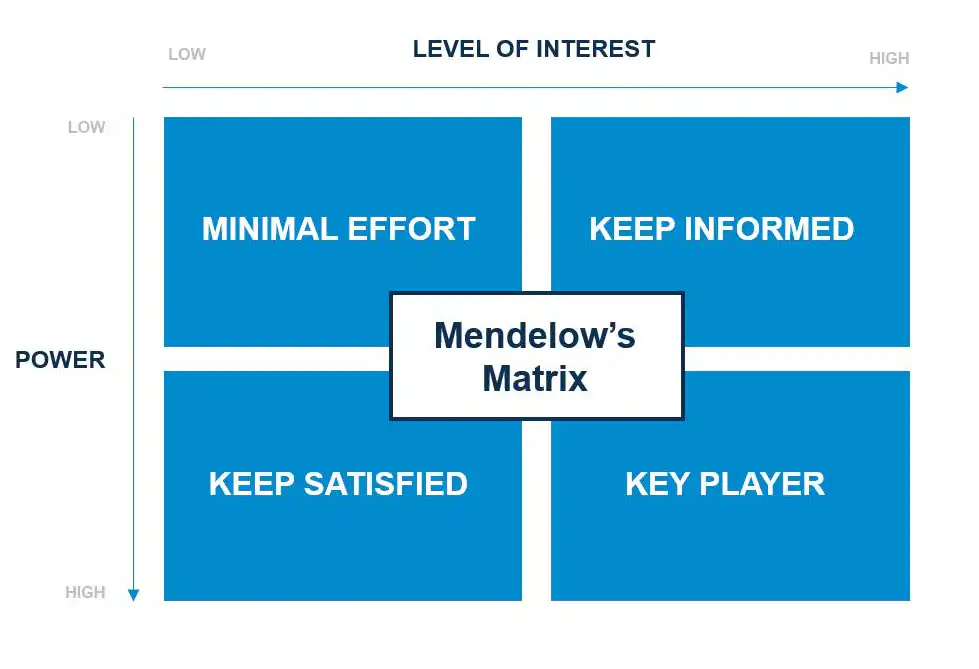
Generally, you cannot approach all stakeholders in the same way when their expectations and/or requirements differ. By analyzing and categorizing stakeholders, you can create segments. This forms the basis for tailoring your approach to the various target groups. It can also be helpful to map out the relationships between stakeholders. Who knows whom? And who influences whom?
3. Building Relationships with Stakeholders
Once you have defined the segments of your target audience, you can work in a targeted manner to build relationships with your stakeholders. A key characteristic of stakeholder management is that the approach to stakeholders varies widely, depending on the sensitivity of the issue, the relative numbers involved, and so on. For example, you might invite one target group to an informational session, while it’s better to send another target group a letter or email, or to approach key individuals in person. Often, different procedures apply as well. For example, responding to a question may differ from handling an official complaint or legal proceedings.
Effective planning and follow-up in engaging with stakeholders are the key to success. That is why a good software tool is important for doing this as efficiently as possible. For example, we are thinking of:
- Conducting communication campaigns, such as disseminating information (via email, mail, website, social media, etc.).
- organizing events or meetings.
- Planning and carrying out networking activities to build and/or maintain relationships.
- Follow-up on meetings: minutes, action items, … .
4. Review, Reporting, and Adjustments
Effective stakeholder relationship management tools provide the necessary reporting capabilities for actions and activities carried out and their results:
- Who in your target audience did you reach (and who didn't you reach), and what message did you use to do so?
- What is the status or health of your relationships with various stakeholders? In other words, who are you on good terms with, and where do you still need to make improvements?
Based on these reviews and reports, you can then draw conclusions about follow-up activities to build, maintain, and improve relationships.
Features of Business Software for Stakeholder Management
What criteria must business software for stakeholder relationship management meet? Here is an overview.
1. Classification of Individuals, Organizations, and Groups
The better your ability to classify individuals, organizations, and groups, the more granular your segments can be, allowing you to tailor your message to your target audience.
The ability to hierarchical organizational structures Mapping this out is often essential as well. If you can link each department or team to the level above it, a hierarchical structure with an infinite number of levels becomes possible. In government organizations, a hierarchy with more than five levels is not uncommon, but it is also important for holding companies, nonprofit organizations, and others to be able to map out the organization’s hierarchical structure.
2. A 360° view of the stakeholder
This is about the ability to centralize all key information about stakeholders into a 360° view. You can then create segments based on all features and based on the behavior (interactions) to enable targeted communication. For example, the selection of local residents who live on streets X, Y, and Z and who attended a specific information session. This is very useful if you are planning a targeted communication campaign or if you want to organize an event and invite these individuals.
Digital Marketing Tools allow you to track who has received and viewed which information. However, if the data from these interactions is stored only in a separate application, it’s obviously of little use to you.
3. Omnichannel Communication
Omnichannel communication is no longer a luxury—it’s an essential requirement. It should be possible to centrally collect and process communications received via email, chat, the website, online surveys, social media (Facebook, LinkedIn), and telephone.
You should be able to automate outbound communication via email, letters, and social media. For example, through automated email workflows that vary depending on the recipient’s previous interactions.
4. Case Management
Of course, you also need to be able to centralize and systematically handle incoming questions or complaints received through various channels (website, phone, mail). In this context, it is important to be able to intelligently route each “case” to the appropriate employee. Furthermore, it is also very useful if the software tool can automatically match the content of the case with an available knowledge article and/or similar cases.
5. Information Security and Privacy
You sometimes handle sensitive information about individuals and organizations. That is why it is important to configure access to that information so that no one can view more information than is necessary to perform his or her job. Your business application must meet the strictest requirements in the area of Information Security and Privacy (GDPR).
6. Event Management
A tool is needed to organize events such as information sessions event planning come in handy. At the very least, you need to be able to invite people, have them register via an online form, and track attendance. Furthermore, this should also work seamlessly for online events.
7. Survey tool
There is no shortage of survey tools for gathering opinions or information. But if survey data isn’t centrally linked to the stakeholder, the value of the information collected is limited. With a survey tool integrated into your CRM application, you can automatically send out survey requests and then link the responses directly to the appropriate contact person and organization. This completes the 360° customer view and makes it easier to track feedback and progress on an individual and organizational basis.
8. Automatic Update
Information about individuals and organizations is constantly changing. That is why it is particularly interesting to gather information automatically to update by linking to a reliable source of information.
- For business information: a link to Graydon, Trends Top, VKBO, and others.
- For individuals: a link to LinkedIn or specific business directories.
- For government organizations, a link to the national registry or population registry.
Data integration automatically keeps your CRM database up to date. This helps you minimize errors in communications caused by outdated data.
9. Web portal for stakeholders and/or external employees
You may want to allow stakeholders and/or external employees to make information accessible to a portal website. You can save a lot of time and resources by taking this feature into account when selecting technology.
Consider, for example, an online platform where people can ask experts questions, and those experts answer them online. Another example: a website designed to proactively share information with local residents about planned infrastructure projects and to gather feedback from them.
Microsoft Dynamics 365 and Power Platform for Stakeholder Relationship Management
The standard out-of-the-box apps in Microsoft Dynamics 365 and Power Platform include everything an organization needs. From omnichannel communication in Dynamics 365 Customer Service to marketing automation in Dynamics 365 Marketing and data analysis in Power BI.
Stakeholder relationship management, of course, varies greatly from organization to organization. The flexible adaptability of Dynamics 365 and Power Platform, and therefore a major asset. Thanks to Microsoft’s ecosystem of business applications, you simply can’t get stuck. All business apps are fully integrated and modular, allowing you to use only the components that are relevant to you. In addition, you’ll always have the flexibility to add apps to your digital work environment in the future. This is particularly useful if you’d like to expand your toolset later with a Power Apps portal or mobile apps to exchange information with stakeholders.